Sustainability is the only way forward for industry that does not lead to an environmental dead-end. Waste recycling has its place, but researchers in France suggest that from the outset the design of a product should consider the whole life cycle to offer any chance of sustainability. Writing in the International Journal of Design Engineering, the team explains how this approach might best be adopted by industrial and other designers.

“The concept of sustainable development was proposed as a solution to this situation during the 1980s,” the researchers explain, “This concept calls upon each actor, especially industry in its role as the pillar of developed societies, to strike a balance between the social, economic and environmental dimensions of its activity.” It is an increasingly critical factor to be addressed in the face of a rising global population, diminishing resources and climate change.

Dominique Millet and Nicolas Tchertchian of the Design and Ecodesign Methodology Lab, at SUPMECA in Toulon, working with Daniel Brissaud of the INPG, GSCOP Laboratory, in Grenoble, point out that there are many “eco design” tools on the market. However, very few of these are actually used by design teams because few help in green design and do not offer good results in terms of radical environmental improvements.

Others have suggested that addressing environmental issues earlier in the process offers designers more chance of success. However, there is a current lack of off-the-shelf design tools and decision-making methods available to simplify this process from the start. Such tools could help close the loop of materials, energy, waste and other criteria, such as pollution, Millet and colleagues explain.

Moreover, such tools if they existed would be the only ones that could contribute to a radical strategy of environmental improvement which would not be a mere “green fix” further into the manufacturing process and would not improve environmental credentials to the detriment of functionality and cost to the consumer.

The team has now developed a design tool that encapsulates the following principles: the ability to correctly define the performance of product, usability, effectiveness of the method in assessing environmental performance, ability to provide new solutions, possibility to review the design activities, and ability of the method in fitting into a certain design process.

Their tool incorporates the following five steps into a computer program.

  1. A product model is defined generically based on existing products on the market.
  2. The design team considers what might be improved in the generic model.
  3. Suggested improvements are validated based on technical and economic factors and user attractiveness.
  4. Environmental performance and ecological indicators are assessed.
  5. Design results and experiments are interpreted as a hierarchy and assessed.

“We are convinced that only this type of approach will enable true eco-innovations to emerge,” the team concludes.

Source: Science Daily
Many homeowners here in the mountains of Colorado opt to include some type of outdoor living space in the plans for their home. Enjoying the cool mountain breezes while spending time with family and friends is a favorite activity among many residents here in our region. For us, it is just as important to include eco-friendly materials in outdoor living spaces as it is within the homes we build. Recently, Elle Décor featured a short article on the top trends for eco-friendly flooring materials for outdoor living spaces. If you’re thinking about adding an outdoor living space to your home, you may want to consider using some of these materials for your flooring.

  • Gravel – Gravel has been a staple product for landscapers for many years, and it’s expected to make a big comeback this year. Crushed stone is suggested over pea gravel, as pea gravel is a nonrenewable resource.
  • Pavers – Pavers made of local stone enhance the look of the native plants in your landscape, plus it’s better for the environment than a stone imported from far away.
  • Decomposed Granite – Decomposed granite is very much like sand and is a slight shade of pink, which Elle Décor suggests would be a great accent for outdoor dining rooms.

It's just as important to include eco-friendly materials in your outdoor living spaces as it is to include them inside your home.

You can check out more ideas at Elle Décor.

Image Courtesy of Stephen Orr via Elledecor.com.

Figuring out Energy-Efficient Mortgages and Making Room for Green Building Budget No Matter How Big or Small.

Whether you are building on a shoestring or have an abundance to spend on the green design home of your dreams; We must all have a budget for sustainable building and renovation expenses planned out before the real work begins. Like all budgets, a sustainable building/renovation budget will keep your expenses in check and will allow you to make improvements efficiently as possible.

Some of the questions you must ask before starting the green building project is how are you going to pay for it all? Another important question that potential builders and home owners must consider is the federal tax breaks and incentives for green building and remodeling. As President Obama made a point in his 2011 State of the Union address, green building is becoming a core part of the “American Dream” and rightly so. So how do we come up with the money and how do we utilize that money to save us money in the long term?

While some builders might have couple of thousands of dollars in savings, most do not have tens of thousands needed to complete most big green building  jobs. Some of the budget could be offset by loans such as home equity loan or home equity line of credit, says John Barrow and Lisa Iannucci of “Complete Idiots Guide to Green Building and Remodeling”. Good news is there are several specific loans for energy-efficient upgrades like Energy Efficient Mortgages (EEMs) and Energy Improvement Mortgages (EIMs). Both of these options lets homeowners finance such green upgrades as part of their monthly mortgage bill.

Energy Efficient Mortgages

EEM has a regulation that all homeowners should be aware of. In order to qualify for an EEM, homeowners must first have a Home Energy Ratings Systems report on your home by a qualified Home Energy Ratings Systems (HERS) evaluator. A HERS evaluator will come to a potential home for energy upgrade and will determine if the energy-efficient renovations will make sense financially. The rater will also provide home owners and mortgage companies the recommended upgrades and the estimates of such upgrades. To find a HERS evaluator, check out Residential Energy Services Network.

Three different types EEM loans are available which are through Federal Housing Administration (FHA), Veteran’s Administration (VA) and Conventional loans. An EEM can only be applied to single-home and  condominium which is occupant’s primary residence. “One of the primary benefits of an EEM is that it increases the amount of money you can borrow,” says Barrow and Iannucci.  Other benefits of energy-efficient upgrade includes

  • It allows homeowners to include the total cost of improvements into the total mortgage amount.
  • The value of home will go up due to the energy-efficient upgrade
  • Home owners will also get tax-deductible interest on mortgage payments
  • Home owners will also benefit from lower heating and cooling cost. According to Georgia power, home’s heating and cooling requirements account for more than 50% of the average monthly energy bill.

Tax Credits for Energy-Efficient Upgrades

Here’s the rundown of 2011 Tax Credit according to Energy Star. It’s important to note that not all Energy Star appliances qualify for a tax credit.

Tax Credit:10% of cost up to $500 or a specific amount from $50 – $300Expires:December 31, 2011Details:Must be an existing home & your principal residence. New construction and rentals do not qualify.Save your receipts and the Manufacturer’s Certification Statement for your records.Submit Form 5695 with your taxes.

For more info, Go to Energy Star Consumer Energy-Efficiency website.

Three Categories of Green Building/Remodeling Cost

There are three different categories of expenses in green building and remodeling: construction costs, verification costs and certification fees, according to Michelle Desiderio, Director of Green Building Programs, NAHB Research Center. “These additional costs may deter builders from considering building a green-certified home,” Desiderio says, “But there are ways to significantly reduce or eliminate additional construction costs — and even reduce typical construction and operational costs”.

  • First, figure out where you stand. Check out the free Green Home Scoring Tool provided by NAHB which provide rates for residential green building projects. Consider the frame of the build. Consider using panels or trusses which are both energy and labor efficient. Prefabricated houses are becoming more popular and have the added bonus of thermal efficiency over stick frame.
  • “Another simple method for cutting costs is to develop a cut list — a set of cutting instructions and guidelines for your field crew that ensures the material you purchased for a particular application is used for the intended purpose,” says Desiderio.
  • Optimizing duct works, placing HVAC systems within the confines of the home, creating smaller living space, designing efficient plumbing system and quality assurance are all key factors of building a great and budget friendly green home or building.

Coming up with a budget for such large task of green building is no easy matter. There are home loans to consider. What upgrades would best suit each home or building. Then there is the bigger matter of paying for it all. With some government relief such as the EEMs and EIMs along with federal tax breaks. Green builders and home owners can find some assistance and relief. As we figured out in Week 1, going small in green building is an important step. Then using Bioclimatic Design for green design phase of building, then debunked some green building myths and now figured out a budget to pay for it all. Next series, we will take a closer look at sustainable materials.

Source: Green Building Elements

Source: The Complete Idiot’s Guide to Green Building and Remodeling, Energy Star, Professional Builder

Photo Source: stockxchange: iprolesvilen001

A recent study conducted by the National Association of Realtors has revealed a great deal of information about the types of neighborhoods Americans wish to live in. The Community Preference Survey showed that an astounding number of Americans would prefer to live in a walkable, mixed-use neighborhood, otherwise known as smart growth neighborhoods, over those that require them to drive between work, home, and recreational activities, according to Residential Design + Build magazine.

77 percent of Americans surveyed by the National Association of Realtors said they look for neighborhoods with pedestrian-friendly features like this one in Florida.

The survey’s results revealed that 77 percent of the respondents said they look for neighborhoods with sidewalks and pedestrian-friendly features, while 50 percent noted they would like to see improvements to existing public transportation over new roads and developments. The survey also revealed that consumers would willingly sacrifice square footage space for less driving.

Ron Phipps, the President of the National Association of Realtors, said “Realtors care about improving communities through smart growth initiatives… Realtors understand that different home buyers are looking for all kinds of neighborhood settings and that many home buyers want walkable, transit-accessible communities.”

Image Courtesy of EPA Smart Growth/Flickr via Switchboard.nrdc.org.

Florida’s First Commercial Net-Zero-Energy Building Is Generating More Energy Than It Consumes.

A few years ago in central Florida, John Santarpia had an idea. He was the president and CEO of a credit union and felt he needed to do something to improve its image. He and his colleagues had found a lot in Lakeland, a city of about 100,000 residents, with an ice cream shop on it. Knowing the community wouldn’t be in favor of losing the ice cream shop, Santarpia decided to build a flagship building for his credit union around it. Whatever it was, he wanted to make it green. What resulted was the state’s first commercial net-zero-energy building.

The difference is that Santarpia was interested in new technology and was attracted by the fact that there were no net-zero commercial buildings in Florida yet, Tim Hoeft, a sustainable engineer atStraughn Trout Architects, said. Santarpia wanted his to be the first.

Although it is still loosely defined, net-zero usually means a building that produces as much energy as is consumed. The Department of Energy‘s website lists eight net-zero-energy commercial buildings up and running in the country. Most are small and in mild-weather environments. But the DOE number could be misleading because it relies on owners to voluntarily submit their building’s information. At the New Buildings Institute, Technical Director Mark Frankel estimates the real number could be closer to 25, with about 50 more in construction.

Santarpia’s building is among those not listed by the DOE. Through the construction and rebranding process, the credit union’s name changed from Community First to Magnify, in part to reflect a new, green identity. The decision to make the building net-zero evolved on its own. First, Santarpia and his colleagues looked into certifying the building under the U.S. Green Building Council‘s Leadership in Energy and Environmental Design program. Once they figured out how to do that, they looked into putting solar panels on the roof.

During construction, Santarpia sought help from local design and construction professionals as well as the local utility company. They ended up with a rectangular-shaped building with just over 4,000 sq-ft of space, high ceilings and an upward-sloping roof. It opened in August 2009.

The building combines control systems with its “double roof” concept. Its top layer of solar panels shades it from direct heat gain. The space between the roof layers, along with its slope, helps the hot air convect, or rise and disperse, instead of raising the temperature in the building.

Solar panels on the roof generate energy, although the building still draws from the grid when it needs to. Other energy-saving mechanisms include using Energy Star-labeled appliances, using equipment to shade the inside from Florida’s hot sun and applying high-performance insulation to further reduce solar heat gain. A utility bill in October of last year confirmed the net-zero claim when it found that the building was generating more power than it was using. Forty-five percent of the energy produced in the panels goes back into the grid.

Net-zero has potential in a booming industry

In theory, at least, there is a big pot of money that entrepreneurs with net-zero ambitions can draw from. Each year, more than $600 billion is spent on new construction and renovation of commercial buildings, according to the Commercial Buildings Consortium (CBC). But adding the technology to commercial buildings — which use 40 percent of the country’s energy and make up 40 percent of its greenhouse gas emissions — is a challenge.

Last month, President Obama announced the Better Buildings Initiative, which sets a target to improve commercial buildings energy efficiency by 20 percent over the next decade.

Depending on how they’re defined, net-zero-energy buildings may take what Obama envisions one step further. Usually, net-zero refers to buildings that don’t use any more energy than they produce. Once the buildings are running, they must meet the energy rules set before construction to stay true to the net-zero claim.

Two reports released last month by the CBC detail ways for new buildings to achieve net-zero-energy status.

The CBC, an umbrella organization that includes more than 430 organizations representing commercial building interests, says no formal definition exists for net-zero. Both reports lay out a “directional goal” to get there. One focuses on technology barriers, while the other looks into market barriers like building codes and standards.

Jeffrey Harris, senior vice president for programs at the Alliance to Save Energy, says that the magnitude people are talking about for net-zero is an 80 percent reduction of energy consumption from today’s levels.

Their small, one-story size gives net-zero buildings plenty of daylight. Mild-weather environments allow them to ease use of air conditioning and heat. It’s also hard to put them in urban environments because shading from nearby buildings will affect natural lighting.

‘Keep building standards flexible’

One unintended consequence of building many of these with the available technology could lead to a groups of small, low-level buildings spread out in a sprawl. The CBC doesn’t want this to happen.

A way to avoid this would be to be flexible about standards. A new 30-story building may need 10 times as much energy as a three-story building, Harris said, but it could still produce as much energy on a square-foot basis. That 30-story building may not be self-sufficient, but it would still save energy.

Harris identifies three immediate areas to help achieve net-zero: integrated design, efficient control systems and lifetime performance assurances. In other words, a building’s design process must include input from designers at all levels. Its control systems must work together, and it needs a system to monitor its performance.

Harris describes integrated design as “making sure the new building’s team brings in energy efficiency teams to take account of how changes in one system can affect another.”

Diana Lin, a program manager with the National Association of State Energy Officials, said the process could include lighting designers, engineers, contractors and other “downstream actors.”

“Oftentimes, a building owner comes in with an idea and an architect designs it” and it stays at that, Lin said. What could result is an inability to understand how a building’s many different systems work together. Bringing all levels of designers in at an early stage would give them a chance to provide input. It would also help developers understand how a building’s different systems interact, Lin said.

The Magnify building, which used a lot of the same building processes later laid out by the CBC reports, is an ambitious venture for a credit union. The investment in it won’t pay for itself for maybe 15 years. Santarpia said all the press coverage and attention has led to new customers. But most mid-sized credit unions can’t afford to wait that long for money to come back.

Source: The New York Times– Edited by Amanda McLeman, Consulting-Specifying Engineerwww.csemag.com

Did you know April is considered New Homes Month? If you’ve been thinking about planning and building a new home, now is definitely a great time find information on constructing your dream home! Current homeowners looking to build a new home and prospective homeowners alike can find lots of beneficial information on the National Association of Home Builders website. There you can find resources on the home building process, as well as the basics on financing a home and so much more information that can help make the process of becoming an educated consumer a lot less stressful.

Trilogy Partners can help you create the home of your dreams! Since 1998, we have partnered with our clients to create custom homes throughout the Colorado mountains. We use an integrated design-build process to serve our clients from concept to completion. Visit our website or contact us to learn how we can help you build the mountain home you’ve always dreamed of!

Contact Trilogy Partners to begin planning your new home!

Image Courtesy of Trilogy Partners.

Last month we told you about the National Association of Home Builders’ (NAHB) survey study that was presented at the NAHB International Builders’ Show, which revealed what builders expect new homes to be like within the coming years. That survey study predicted that homes will become greener and smaller by 2015. Recently, the NAHB told Builder magazine exactly how small they expect homes to be in a matter of two years.

According to Builder magazine, the average home is currently about 2,380 square feet in size, but the NAHB expects that number will drop to 2,150 square feet by 2013. Stephen Melman, the director of economic services for the NAHB, noted that affordability is driving all the decisions when it comes to new homes. He said that home buyers, especially those looking at custom homes, are saying “This is how much I can spend. How can we make it fit?”

One way smaller homes will achieve an open feeling as the average home size decreases is through a spacious, open floor plan. Many consumers have noted that a great room, as opposed to several smaller rooms, is the No. 1 item on their wish list for a new home. Additionally, walls are being eliminated, ceilings raised, and brighter, more interesting materials are being used to make spaces fee larger.

We found this information to be very interesting and intriguing. If you would like to read more, check out the article “The Shrinking New Home” on the Builder magazine website.

Photo credit: Nahb.org.

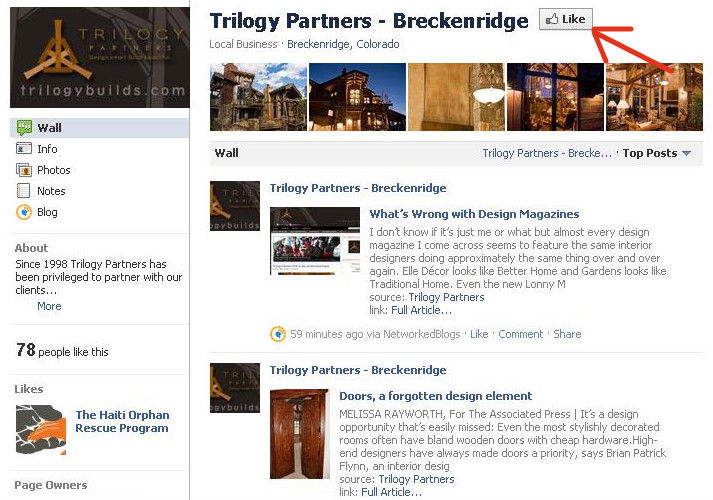
Have you connected with Trilogy Partners on Facebook yet? If not, be sure to stop by our page the next time you log into your Facebook account and click the like button on our page. By liking our Facebook page, you’ll receive our posts in your newsfeed, so you’ll never miss an update. Our Facebook page is the place to be for all the news and information in sustainable building practices, design tips and trends, events and happenings, and so much more!

Once you’ve liked our page, do us a favor by suggesting it to all of your Facebook friends. We currently have 78 people following us on Facebook, and we’d love to see that number rise to 100 over the weekend, but we need your help to accomplish that goal. Also, be sure to like The Haitian Orphan Rescue Program on Facebook, too. The Haitian Orphan Rescue Program is a charity co-founded by Trilogy Partner Michael Rath that provides permanent shelter for orphaned and abandoned children in Haiti.

We hope to see you around the Trilogy Partners Facebook page soon!

A couple of months ago we told you about a huge milestone the U.S. Green Building Council (USGBC) reached with one billion square feet of LEED-certified space. Recently, the USGBC announced that over 10,000 homes in the nation have attained LEED certification through the LEED for Homes program.

Nate Kredich, vice president of residential market development for the USGBC, said “Reaching this milestone signifies the continued transformation of the home building industry towards high-performing, healthy homes that save home owners money. Market leaders across the production, multifamily, affordable and custom home segments have recognized that there are green homes, and then there are LEED Homes, and they are acting accordingly.”

The ribbon cutting ceremony for the Salishan 7 project took place earlier this year. The Salishan 7 project was the 10,000th project to receive certification through LEED for Homes.

Green Building Pro reports that since the program’s launch back in 2008, 10,161 homes have been certified. The 10,000th home to earn LEED certification was the Tacoma Housing Authority’s 91-unit development, Salishan 7. That project was also the first federally funded HOPE VI Redevelopment project to achieve LEED Platinum status.

This is a huge moment in the LEED for Homes program and Trilogy Partners is thrilled to have contributed to over 10,000 homes becoming LEED-certified!

Photo credit: Tacoma Housing Authority.

We like to keep up with everything that’s going on in the world of LEED certification here at Trilogy Partners, so we found this news to be really cool. Students studying architecture at Tulane University, along with their professors, have built the first LEED-certified residential project for a first-time home buyer in New Orleans.

According to Editor at Large, this project was a collaboration between URBANbuild, a design-build program at Tulane University in which students take part in, designing and constructing prototypical homes in neighborhoods throughout New Orleans, and the Neighborhood Housing Services.

The home’s owner, Tami Hills, was thrilled to receive a certificate honoring her home’s energy-efficient design. She noted having insulation as one of her favorite aspects of her home because for the first time since she began living in New Orleans, she is “warm in the winter and cool in the summer.”

The porch of Tami Hills' LEED-certified home in New Orleans.

Additional green features of this LEED-certified home include low-E windows, Energy Star electrical features, an energy-saving air conditioner, and sustainable materials such as bamboo flooring and zero-VOC interior paint.

We think this is awesome news for the LEED program! You can learn more about this project at Editor at Large.

Photo credit: Editoratlarge.com.

965 N Ten Mile Dr. , Unit A1 Frisco, CO 80443
Phone: 512-413-2593

Email: gregb@trilogybuilds.com
Facebook: TrilogyPartners
Twitter: @trilogybuilds
Instagram: trilogybuilds
Youtube: The Trilogy Partners Channel